Table of Contents
Based on your psychiatrist’s diagnosis, your treatment will consist of one or two treatment sites and will be programmed at a specific frequency. At our Glendale TMS clinic, treatment protocols are customized based on each patient’s diagnosis, symptoms, and treatment goals.
In this blog, we explain the different TMS treatment sites, frequencies, and protocols used to treat depression and anxiety.
TMS Treatment for Depression: Left Dorsolateral Prefrontal Cortex (LDLPFC)
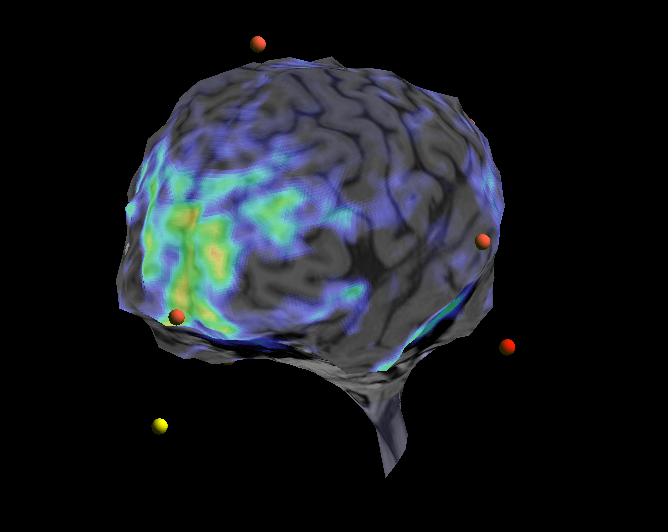
A patient who is being treated for depression will have a target site on the left dorsolateral prefrontal cortex. The left side is targeted for depression since our left brain is what governs our positive emotions.
Patients with depression have an imbalance in these positive emotions; treating with TMS will result in increasing the brain activity on the left.
TMS Treatment for Anxiety: Right Dorsolateral Prefrontal Cortex (RDLPFC)
A patient who is being treated for anxiety will have a target site on the right dorsolateral prefrontal cortex.
The right dorsolateral prefrontal cortex is responsible for:
- our survival instincts and fear
- triggering our hyper-awareness of threats
- negative emotions.
Individuals with anxiety will have heightened activity on the right side. Therefore, the TMS treatment will inhibit activity on the right side. Treatments on the right side of the brain are not FDA approved, but widely utilized amongst TMS providers.
What Is the Dorsolateral Prefrontal Cortex (DLPFC)?
The dorsolateral prefrontal cortex is the major target site for many depression and anxiety TMS protocols. This region of the brain is the brain’s “control center,” responsible for emotional regulation, motivation, and executive function.
The DLPFC is connected to many difficult-to-reach brain regions, such as the amygdala and the cingulate cortex. The amygdala is responsible for emotional memory and regulation, and triggers our physical responses to danger. The cingulate cortex serves as a bridge between emotional processing and cognitive function.
iTBS vs rTMS: TMS Protocols for Depression
The left-sided treatments usually range from 3 to 19 minutes, depending on whether the patient is undergoing accelerated or standard treatment. Two of the most common TMS protocols for depression are Intermittent Theta Burst Stimulation (iTBS) and Repetitive Transcranial Magnetic Stimulation (rTMS).
What Is 50 Hz iTBS?
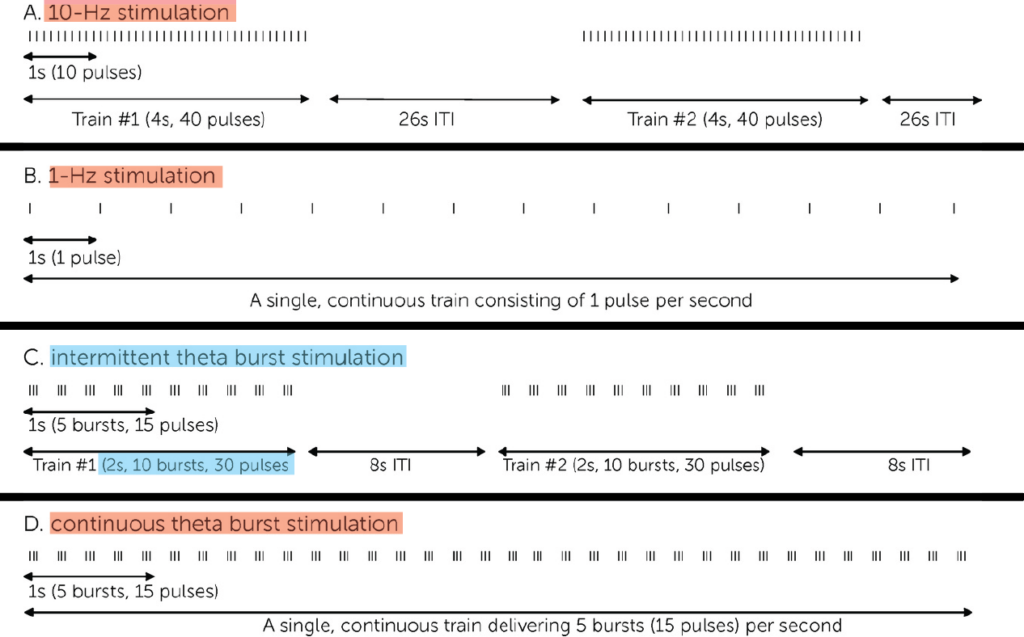
iTBS (intermittent theta burst stimulation) is an intermittent pattern known to have an excitatory effect. With iTBS, magnetic pulses are delivered in “bursts” of three, delivered in a 2-second train followed by an 8-second pause.
This pattern and magnetic pulse cause an increase in our brain’s excitatory chemical, known as glutamate. It also leads to a decrease in our brain’s inhibitory chemical called GABA. Overall, this increases excitatory activity in the left hemisphere of our brain, addressing the underactivity associated with depression.
iTBS is delivered at 50 Hz during our accelerated treatments.
What Is 10 Hz rTMS?
The other frequency used in our clinic for depression is 10 Hz, and this treatment lasts around 19 minutes and is our standard treatment. This pattern is known as rTMS (repetitive TMS) and consists of a 4-second burst followed by a 10-second break.
The burst-and-pause pattern of rTMS leads to the same effects: increased glutamate and decreased GABA, ultimately increasing brain activity on the left.
Both protocols have been shown to be clinically effective for treating depression.
Continuous Theta Burst Stimulation (cTBS) vs Low-Frequency Stimulation for Anxiety Treatment
The right-sided treatments can last 5 to 22 minutes, depending on your exact protocol and treatment frequency. Both protocols are known as inhibitory because they dampen activity in the brain’s right hemisphere.
What is 50 Hz cTBS?
Continuous TBS, or cTBS, is a single continuous train that delivers 5 bursts per second.
cTBS has an inhibitory effect because this pattern weakens synaptic strength between excitatory neurons on the right. The 50 Hz cTBS is around 5 minutes.
What is 1 Hz Low-Frequency Stimulation?
Both protocols have similar clinical outcomes, but cTBS delivers treatment at a faster rate.
Which TMS Protocol Is Right for You?
The best TMS protocol depends on your diagnosis, symptoms, treatment history, and physician recommendations.
At our Glendale TMS clinic, we use individualized treatment planning to ensure precise targeting of the brain regions associated with depression and anxiety.
If you are considering TMS therapy, our team can help determine which protocol may be most appropriate for your needs.
Dr. Thomas Hughes is an adolescent and adult interventional psychiatrist. He is the owner and founder of Heard Medical and NeoPsych in Glendale, CA. He specializes in medication management and Transcranial Magnetic Stimulation for depression, anxiety, OCD, and PTSD.
Esha Nushrat is a pre-medical student interested in Neurology. She has been working in mental health and volunteers at organizations such as Stride in Recovery and NAMI
This blog post has been medically reviewed by Dr. Thomas Hughes, the practicing provider at NeoPsych.