
Table of Contents
If you or a loved one is struggling with OCD, then you are aware of the challenges that come with finding a treatment that works best. In this blog post, we will talk about two potential treatments with TMS to treat OCD.
What is OCD?
OCD stands for obsessive-compulsive disorder, and is a condition in which one experiences a pattern of unwanted thoughts and fears, known as obsessions. These obsessions lead to repetitive behaviors, which are called compulsions. Individuals who experience OCD have a reduced quality of life as the obsessive thoughts and compulsions reduce their quality of life.
Obsessions are lasting and unwanted thoughts that are intrusive and cause distress and anxiety. Individuals who experience obsessions try to get rid of them by performing rituals. OCD rituals are the repetitive behaviors or mental acts that an individual performs in response to the obsession.
Compulsions are the repetitive behaviors or mental acts that an individual is driven to perform in response to an obsession. These behaviors are aimed at reducing or preventing anxiety and distress.
What are the causes of OCD?
OCD can be caused by a mix of genetic, biological, and environmental factors. Individuals with OCD can also have neurochemical imbalances in the neurotransmitters serotonin, glutamate, and GABA. Research has found that OCD consists of defective neural networks instead of a single brain region.
OCD can be inherited, as studies have found that 10-20% of children who have a parent with OCD will develop OCD themselves. The environment can play a role in OCD, such as when the spread of a disease leads to an increase in compulsions. For example, during COVID-19, there was an increase in obsessions relating to the virus.
What are common treatments for OCD?
OCD is commonly treated with therapy, medications, or both used conjunctively. The therapy modalities used to treat OCD include Cognitive Behavioral Therapy (CBT) and Exposure and Response Prevention (ERP). CBT teaches you different ways to think, behave, and react to your obsessions and compulsions. ERP is a type of CBT that gradually exposes you to your fears or obsessions.
Medications used to treat OCD are selective serotonin reuptake inhibitors (SSRIs). SSRIs cause an increase in serotonin levels by keeping an increased amount of serotonin in the synaptic cleft, the space between the two neurons. Medications have been shown to improve OCD symptoms in 40-60% of patients.
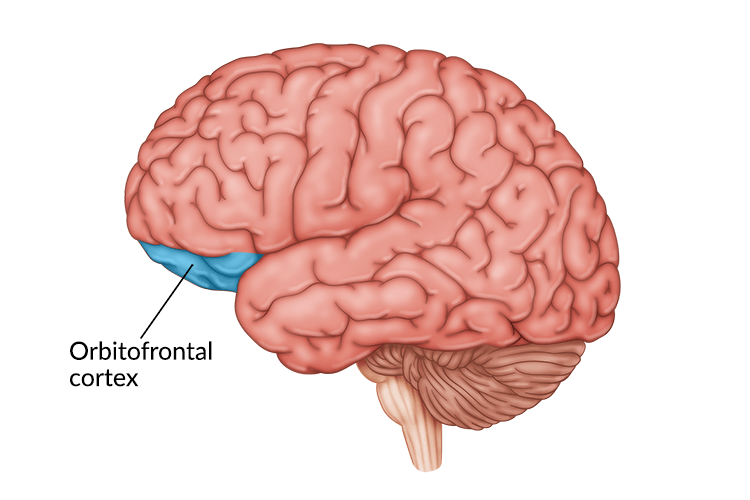
Two brain areas that are essential in the neural network associated with OCD are the right dorsolateral prefrontal cortex and the orbitofrontal cortex. Patients with OCD have increased activity in these regions, as seen from positron emission tomography (PET) scans. Another treatment used for OCD is TMS, which targets these regions with an inhibitory pulse pattern to lessen activity in these regions.
What is the right dorsolateral prefrontal cortex?
The right dorsolateral prefrontal cortex (RDLPFC) plays an important role in processing fear, stress, and emotional regulation.
TMS treatment sites targeting the RDLPFC are usually used to treat anxiety, however, studies have been done on its efficacy on treating OCD. It has been found that the use of inhibitory TMS over the RDLPFC had therapeutic effects on treating OCD symptoms.

What is the right orbitofrontal cortex?
The right orbitofrontal cortex (ROFC) is the region in the front of the brain above the eye socket, and it helps process emotions and decision-making. PET and functional magnetic resonance imaging (fMRI) scans have found an increased activation in the orbital frontal cortex region for OCD patients. Similar to the RDLPFC, use of inhibitory TMS over the ROFC has been found to have therapeutic effects on treating OCD symptoms.
What is better for treating OCD?
Based on a double blind randomized clinical study, there was no significant difference between the two treatment groups. Both the RDLPFC and ROFC regions were treated with a low-frequency (0-5 Hz) magnetic stimulation. Low-frequency rTMS was found to be beneficial in both cases because it changed the cortical excitability and normalized the hyperactivity of the brain network seen in OCD patients.
What does NeoPsych offer?
If you are looking for treatment for OCD in Glendale, CA, we offer treatment of low-frequency rTMS on the RDLPFC. For any questions regarding this treatment protocol, feel free to contact our office.
Dr. Thomas Hughes is an adolescent and adult interventional psychiatrist. He is the owner and founder of Heard Medical and NeoPsych in Glendale, CA. He specializes in medication management and Transcranial Magnetic Stimulation for depression, anxiety, OCD, and PTSD.
Esha Nushrat is a pre-medical student interested in Neurology. She has been working in mental health and volunteers at organizations such as Stride in Recovery and NAMI
This blog post has been medically reviewed by Dr. Thomas Hughes, the practicing provider at NeoPsych.